Building a Competing AI Model with Nemotron 3 Ultra
Public analysis for Sovereign Source — 16 October 2026
Nemotron 3 Ultra offers a route to developing a commercial competing model. NVIDIA identifies both its base and post-trained BF16 checkpoints as commercially usable under OpenMDW 1.1. This assessment concerns those specific releases; a family name is insufficient to establish the terms for every model. Ultra model card · Ultra Base model card.
OpenMDW permits broad use of the covered materials and leaves generated outputs unrestricted by that agreement. It contains no competing-model prohibition. Our reading is that this supports commercial fine-tuning, distillation and output-based training, subject to applicable rights and obligations. OpenMDW 1.1.
Two routes to a competing model
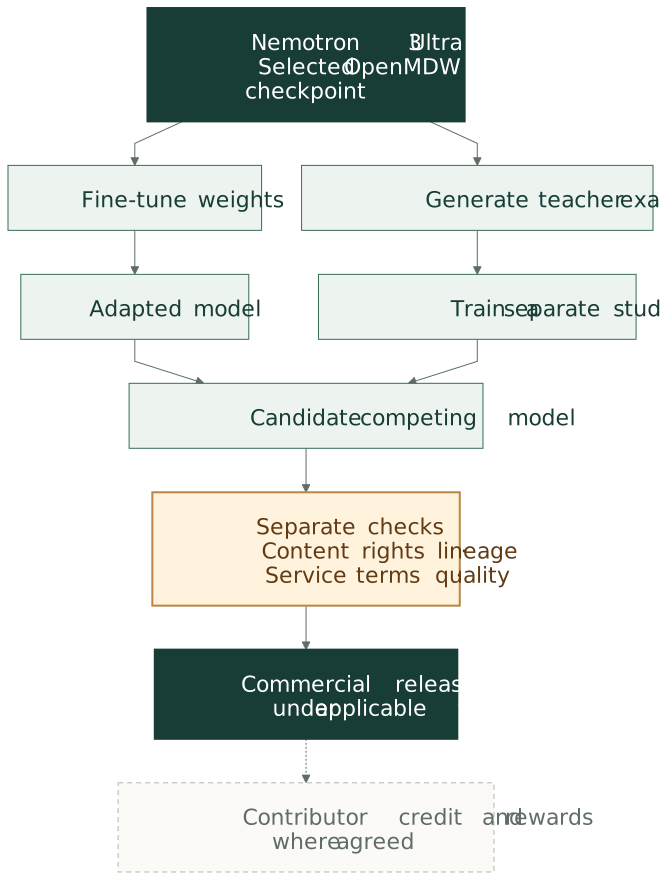
Conceptual development paths, rather than a guarantee of model quality or legal clearance. Download PNG · View SVG · Editable Mermaid source.
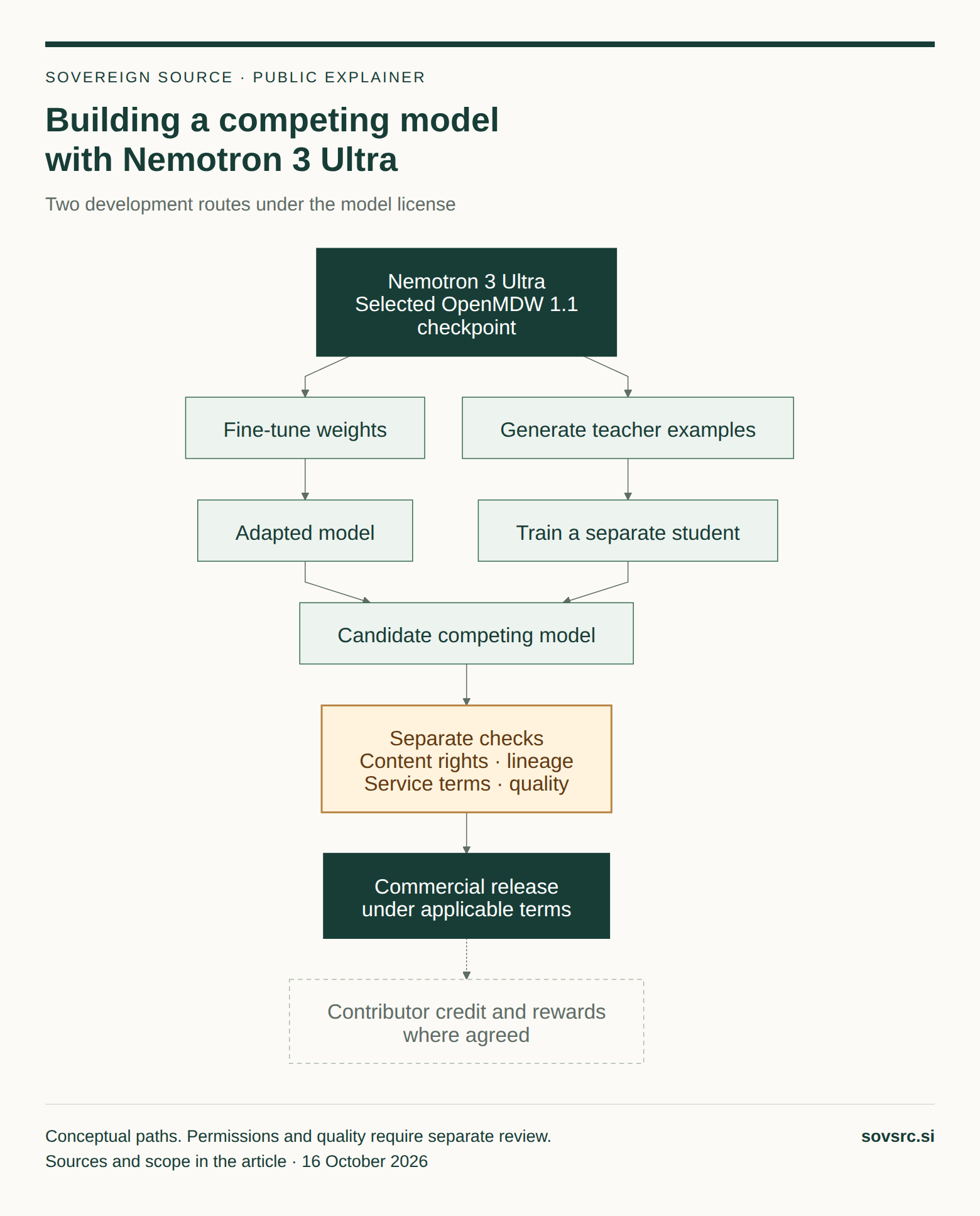
Fine-tuning starts from existing weights. Additional training adapts an established model to selected tasks or material. The resulting model retains its connection to the original checkpoint. NVIDIA describes Ultra Base as a pre-trained checkpoint intended for further training, including domain adaptation and instruction tuning. Ultra Base documentation.
Teacher-to-student training develops a separate model using guidance from another. Distillation transfers behavior through training signals; synthetic examples are one possible source of guidance. The student need not copy the teacher’s weights. The original distillation research demonstrated how knowledge from larger systems could be transferred into a more deployable model. It does not establish that a particular Nemotron student will match its teacher’s capabilities. Hinton, Vinyals and Dean.
These routes answer different development needs. An adapted model begins with an existing set of learned parameters. A separately trained student has its own training process, but still has a documented dependency on its teacher. Calling that student independent should not obscure the origin of its training signals.
What the license requires
Redistribution of covered model materials requires the license and applicable copyright and origin notices. OpenMDW also includes an infringement-litigation termination clause with a defensive exception. It supplies no warranty of title or non-infringement and places responsibility for third-party rights and necessary permissions on the user. It is therefore permission from the provider, rather than universal clearance of every underlying contribution. License text.
Downloaded weights and a hosted service are separate contracting questions. NVIDIA distinguishes model licensing from runtime and enterprise software licensing. A developer using an API should also examine that provider’s agreement for the intended training activity. NVIDIA licensing overview.
Model origin and training lineage
NVIDIA is the developer of Ultra, but its training disclosures include synthetic material generated using Qwen and DeepSeek. Those entries appear in the base checkpoint’s training-data disclosure as well as the post-trained model’s documentation. Selecting the base checkpoint therefore does not establish an absence of those influences. Base training disclosure · Post-trained model disclosure.
A requirement for a US model developer differs from a requirement to exclude Chinese-developed teacher models throughout the training chain. Under the latter interpretation, these Ultra checkpoints do not qualify. This is a provenance finding, not an allegation that those sources were used unlawfully or that their inclusion establishes a security defect.
Competition with contributor rewards
Sovereign Source’s public position is that permission, attribution and contributor rewards deserve separate consideration. A permissive foundation model can give developers room to build. A contribution agreement can separately establish how newly supplied knowledge may be used, how its authors are credited and whether agreed compensation is payable. Project principles.
For example, a publisher could authorize a collection for training and agree on payment for accepted deliveries or documented use. Those terms should make the covered material, permitted activity and earning rule understandable. An existing open license or public-domain freedom should remain respected; a new rewards program should not imply ownership of material its participants do not control.
Training records can support statements about which material was consumed. They should not be presented as an exact measurement of each contributor’s causal share of every generated answer. Attribution and compensation become more credible when their claims match the available evidence.
Nemotron’s commercial permissions make competition possible under the model license. The broader case for an AI product still depends on useful performance, appropriate source permissions and honest accounts of where its capabilities came from. Contributor rewards are a proposed way to support that knowledge supply, with obligations defined by the relevant agreements rather than assumed from the model’s availability.
This is general analysis of the cited releases and terms, not a legal opinion for a particular deployment. Sovereign Source remains a research initiative.